
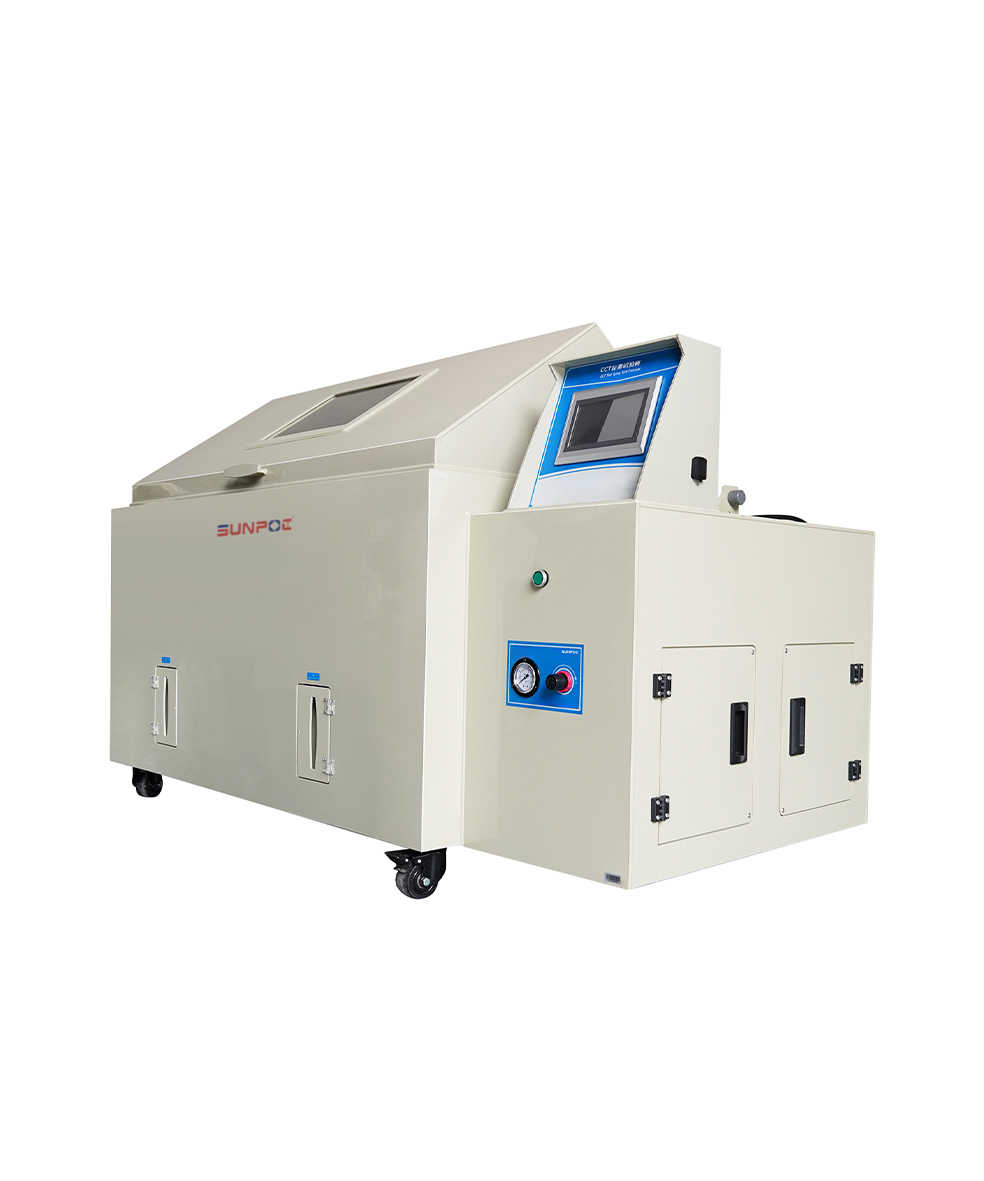
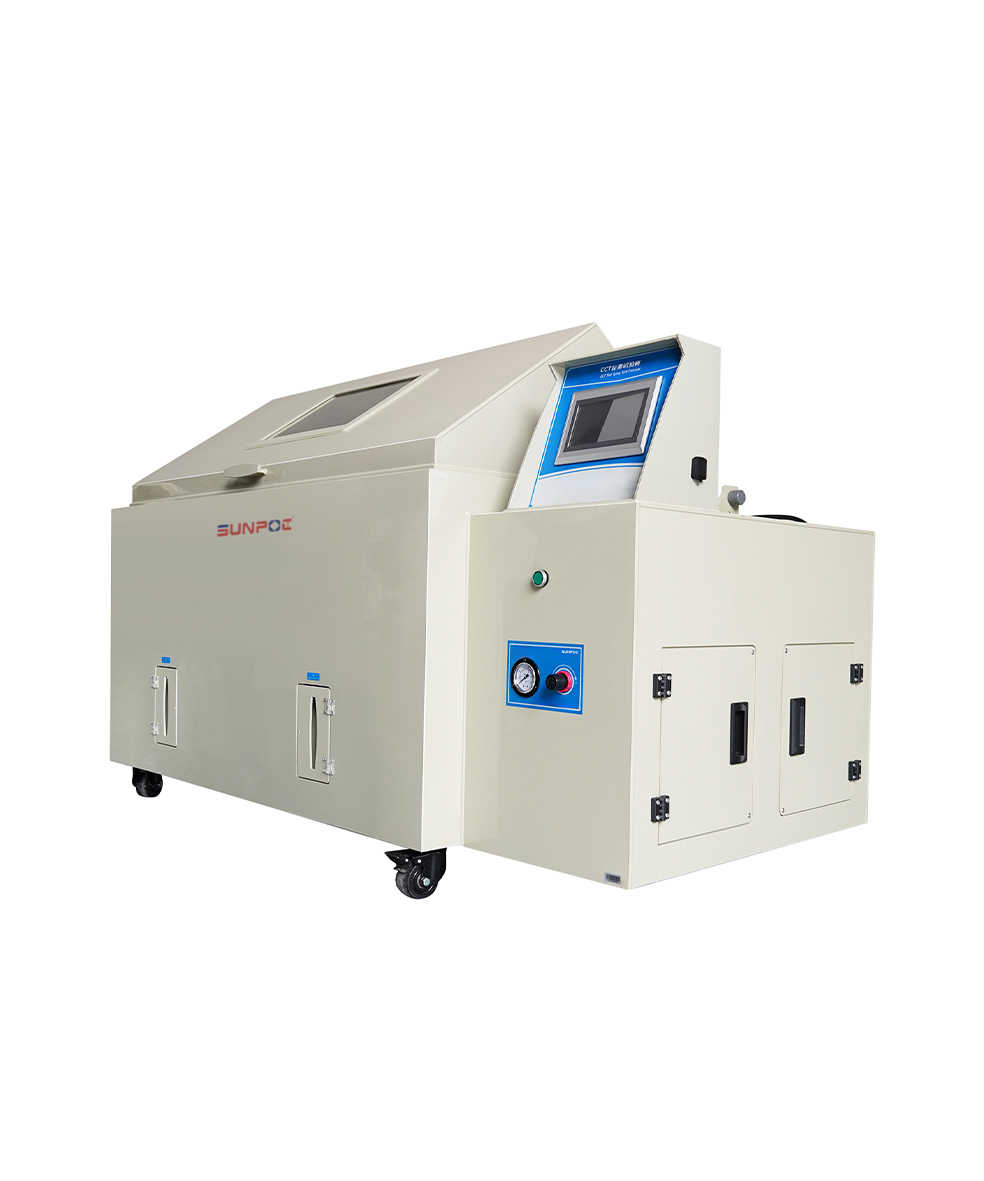
SP-420 CCT Salt Spray Test Chamber
Product Details
Features:
Supports multi-mode composite corrosion tests such as salt spray, damp heat, drying and condensation, meeting various testing standards.
Inner and outer chambers are made of titanium plate and SUS304 stainless steel with anti-corrosion properties, durable and long service life.
Swing spray system ensures uniform atomization without dead corners, with stable and controllable salt spray settling volume.
Precise temperature and humidity control system equipped with titanium alloy evaporator for stable control and corrosion resistance.
Intelligent touch control supports program programming, data recording and remote diagnosis.
Core parts adopt international brands with multiple safety protections for stable and reliable operation.
Main Technical Specifications of Salt Spray Test Chamber
|
1. Product Name and Model |
||||
|
Product Name |
Combined Corrosion Test Chamber |
|||
|
Model |
SP-420-CCT-RT |
|||
|
Internal Dimensions |
100x70x60(W×D×H)㎝ |
|||
|
External Dimensions |
155X95X195(W×D×H)㎝ |
|||
|
Power Supply |
AC1ø 220V 25A 50HZ |
|||
|
2. Materials of Construction |
||||
|
2.1 |
The inner chamber is constructed of 1.0mm thick corrosion-resistant titanium plates. |
|||
|
2.2 |
The external enclosure of the constant temperature chamber is made of 1.0mm thick SUS#304 stainless steel. |
|||
|
2.3 |
The chamber door is made of 8mm tempered glass. |
|||
|
2.4 |
The reagent replenishment tank is made of white PP (polypropylene) board, with a capacity of 50L, designed as a standalone integrated unit. |
|||
|
2.5 |
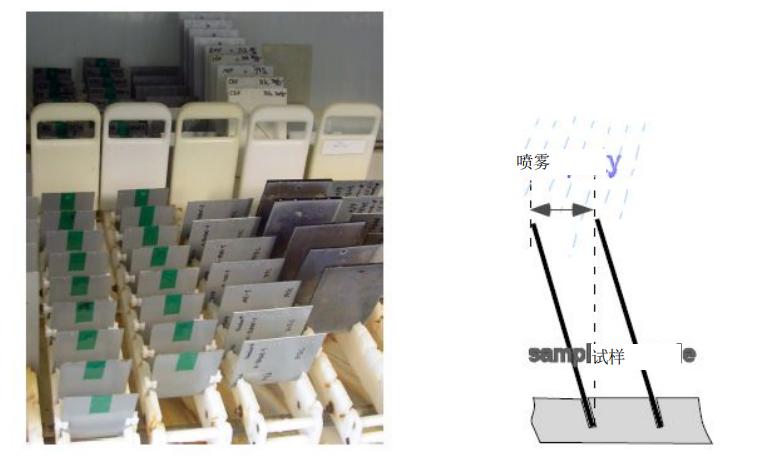
The test specimen racks are made of temperature-resistant GRP angle bars. The specimen testing angle is adjustable to 20°±5°, and customized test holders are available upon request. Refer to the figures below
|
|||
|
2.6 |
Saturated Air Tower: Constructed of 2mm thick SUS#304 stainless steel, equipped with an automatic water level controller to eliminate the need for manual refilling. |
|||
|
3. Operating Test Conditions: |
||||
|
3.0 |
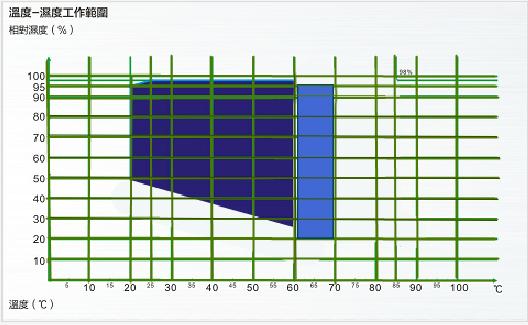
Temperature Range: 10°C ~ 70°C |
|||
|
3.1 |
NSS/AASS Salt Spray Test: (1) Test Chamber: 35°C ± 2°C (2) Saturated Air Tower: 47°C ± 2°C |
|||
|
3.2 |
CASS Corrosion Test: (1) Test Chamber: 50°C ± 2°C (2) Saturated Air Tower: 63°C ± 2°C |
|||
|
3.3 |
Drying Test: Chamber Temperature: 30°C to 65°C ± 1°C Humidity: < 30% RH and ambient humidity |
|
||
|
3.4 |
Humidifying Test: Chamber Temperature: 20°C to 70°C ± 2°C Temperature Deviation: ± 2°C Humidity: 20% ~ 98% ± 5% RH |
|||
|
3.5 |
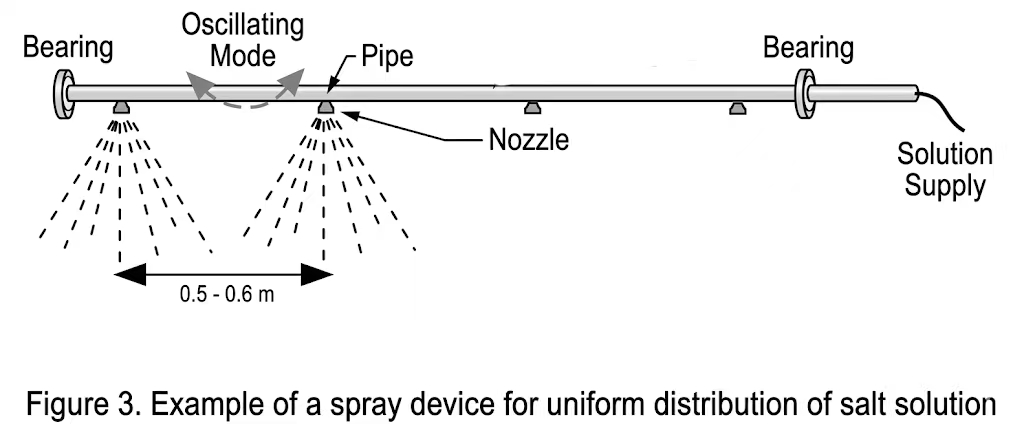
Spray Test: For fully automated test procedures, the chamber shall be equipped with a spraying device capable of properly distributing and uniformly spraying the solution onto the specimens. The most effective method for uniform distribution is a mobile spraying system, such as an oscillating track with overlapping nozzles as shown in Figure 3. The spraying device shall be made of corrosion-resistant materials, preferably plastic.
During the 6-hour humidification phase of a test workday, the target average spray density is 5L/m2, not exceeding 10L/m2. Within the 6-hour period, the spray density at any location inside the chamber must be between 3L/m2 and 15L/m2. |
|||
|
3.6 |
Condensation Test Temperature: 40°C ~50°C (Optional); Humidity: 100% RH and above. Transition Phase to Controlled Humidity Conditions: For fully or partially programmable sequences, the system shall ramp from a nominal 25°C at 95% RH to 40°C at 95% RH within 30 minutes. This ensures that the wet state prevails (2a). Within 2 hours (2b), the wet corroded surfaces shall be dried from 40°C/95% RH to 50°C/70% RH. Under the final controlled climatic conditions, no water traces should remain on the corroded surfaces, and actual values must stay within tolerance. This two-step process—rapid heating followed by slow drying at relatively high humidity—is employed because diffusive drying is superior to convective drying; the latter varies significantly between different chambers, which could severely impact test results. |
|||
|
3.7 |
Heating Method: Thermal radiation is utilized for heat induction to achieve temperature variation and stability within the chamber. This ensures the concentration, specific gravity, and pH value of the collected salt solution during salt spray testing remain consistent. |
|||
|
3.8 |
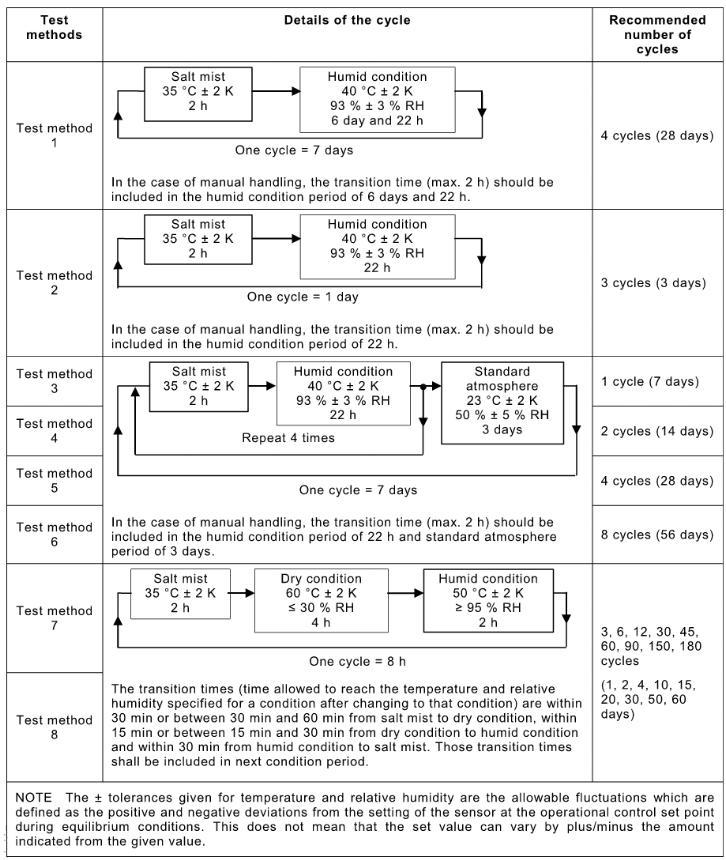
Compliance Standards: Meets GB2423-17/18, GB/T10125, ISO 9227, ISO 7384-1986, GB-T229, Z2371, VCS 1027/1449, CETP, GMW14872, Ford WSS-M1P87-B (Temperature/Humidity ramp rates), DIN, and other standards, such as the following conditions and transition times:
|
|||
|
4 .Atomizing Method |
||||
|
4.1 |
Atomization is achieved by combining a corrosion-resistant pump with pneumatic pressure. The pump regulates the spray volume, producing a fine mist with uniform deposition. This ensures the corrosion effect on test specimens closely simulates natural environmental conditions more effectively. |
|
||
|
4.2 |
Nozzle: Constructed of precision-machined corrosion-resistant resin (in-house manufactured). |
|||
|
4.3 |
Salt Spray Collection Rate: 1~3mL/80cm2 per hour. |
|||
|
5.Defogging Method |
||||
|
5.1 |
The fog is exhausted via compressed air purging (air displacement) |
|||
|
6. Refrigeration System |
||||
|
6.1 |
1. Hermetically sealed refrigeration compressor. 2. Uses R404 eco-friendly refrigerant throughout the system. 3. The heating and cooling systems are completely independent. 4. The test chamber utilizes a titanium alloy evaporator to eliminate corrosion. |
|||
|
7.Humidification and Dehumidification System |
||||
|
7.1 |
1. The humidification and dehumidification systems are required to be completely independent. 2. Water level is regulated by a mechanical float switch to prevent electronic malfunctions. 3. The water supply features an automatic replenishment system, suitable for long-term continuous operation. |
|||
|
8. Control System |
||||
|
8.1 |
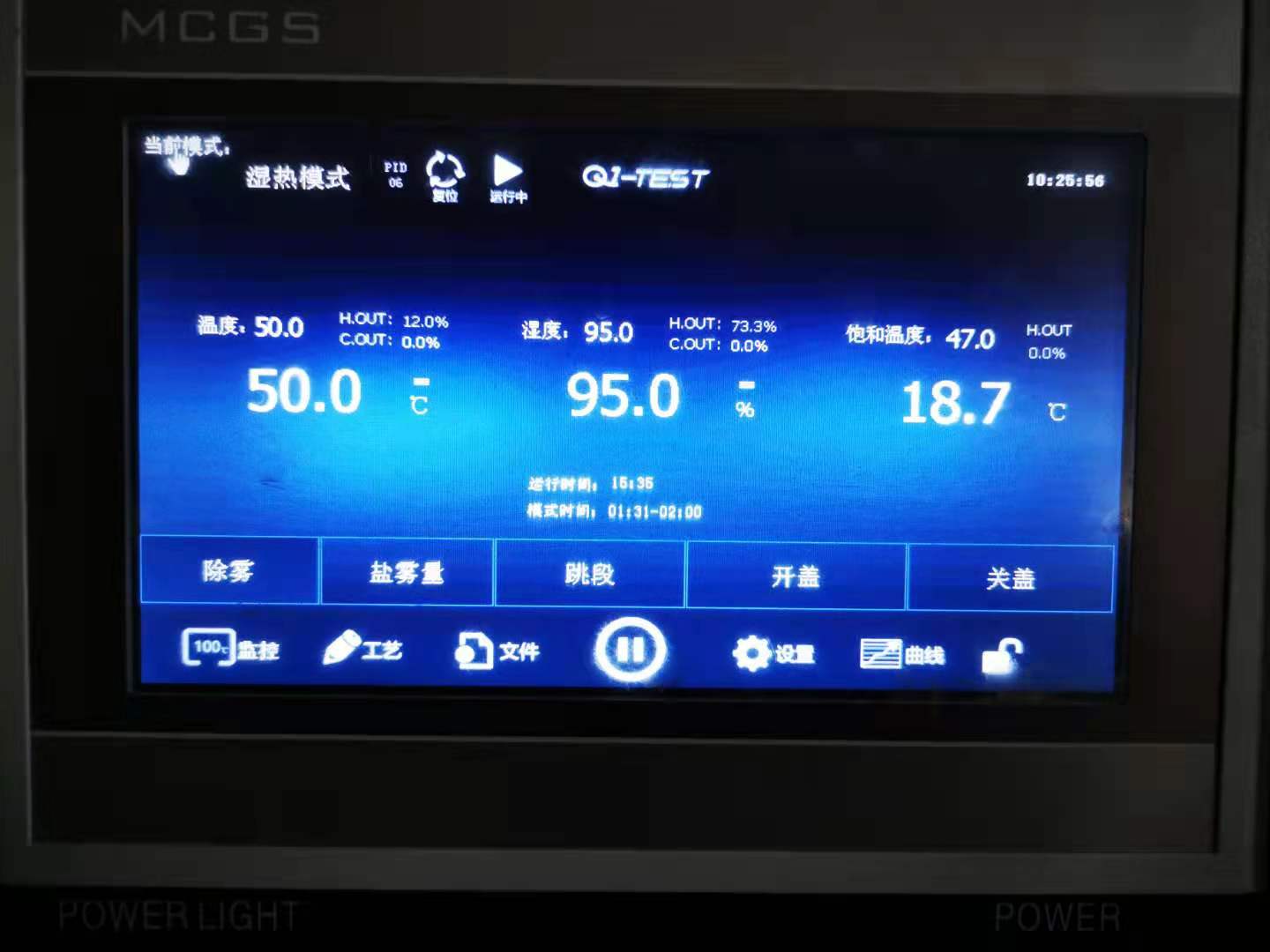
1. High-precision resistive touchscreen paired with the QV.1 temperature control module (in-house developed, featuring a lifetime warranty). 2. 7-inch TFT true color LCD (Resolution: 800*480) with a display accuracy of 0.1. 3. Supports 50 program groups x 50 segments each (each segment can cycle up to 999 times). The number of segments per group is customizable, and groups can be linked/concatenated (up to 10 steps of linking). Programming & Control Software (Key Features) 1. Temp/Humidity Curves: Paperless Recording: Built-in logging program; internal memory supports storage of 24-hour operation data for up to 300 days. Capable of automatically generating temperature/humidity curve files and exporting them as XLS (Excel) spreadsheets. 2. Advanced Interfaces: USB Port: Supports easy data export (historical curves, etc.) via USB flash drives Standard LAN Interface: No dedicated server required; easily connects to the corporate LAN (Local Area Network), allowing a single PC to monitor up to 16 units simultaneously. Equipped with USB or standard communication ports for PC-linked control and management. 3. Real-time Monitoring: Real-time monitoring of 1~16 controllers, including live data, signal point status, and actual output values. Remote (WAN) Diagnostics Support: Technicians can perform remote diagnostics via the internet. With an assigned port from the client, they can access the controller's IP address through a web browser (e.g., IE) to log in, monitor, or troubleshoot. Fault Display: 16 groups of alarm outputs with user-friendly prompts in Chinese and English explaining the cause of the fault and troubleshooting methods. |
|
||
|
8.2 |
Safety Temperature Controllers: Utilizes both digital display and liquid expansion type temperature controllers (Range: 0~85℃), 2 units. |
|
||
|
8.3 |
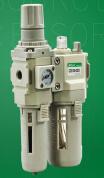
Primary Pressure Regulation Structure: 1. Primary Pressure Regulator: Equipped with 1 set of pressure gauge (pre-regulated at 2~2.5kg/cm2). 2. Secondary Pressure Regulator: Taiwan-made 1/4"PT regulator, adjustable from 0~4.0kg/cm2 (Standard atomizing pressure set at 0.1kg/cm2). 3. Pressure Gauge: 1 unit (2kg/cm2 capacity), Accuracy: 0.1kg/cm2. |
|
||
|
8.4 |
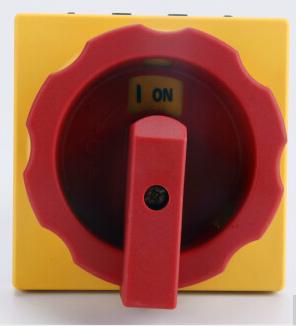
Rotary Safety Switch: Complies with both National (GB) and Internation standards. |
|
||
|
8.5 |
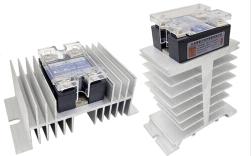
ABB Magnetic Contactor (1unit) and Solid State Relays (SSR) (2 units). |
|
||
|
8.6 |
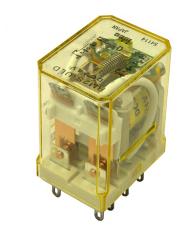
LY2N Protection Relay, 1 unit. |
|
||
|
8.7 |
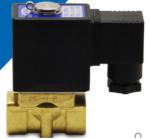
QJA V2A702-03 Copper Solenoid Valve, 4 units. |
|
||
|
9. Safety Devices |
||||
|
9.1 |
Touchscreen Fault Display: Includes water level controller alarms, status alerts, over-temperature protection, and automatic cycle completion notification. |
|||
|
10. Others (Accessories List) |
||||
|
10.1 |
Specimen Support Bars (1 set): Designed to support heavy test specimens or accommodate customized racks. |
|||
|
10.2 |
Sodium Chloride (NaCl) Reagent: 500g per bottle, 4 bottles included. |
|||
|
10.3 |
Saline Solution Mixing Tank (10L): 1 unit. |
|||
|
10.4 |
Imported Standard Collection Funnels (80cm2): 4 units. |
|||
|
10.5 |
100ml Graduated Cylinders: 4 units. |
|||
|
10.6 |
Operation Manual & Technical Standards: 1 complete set. |
|||
|
10.7 |
Salt Fog Exhaust Gas Collector (Optional) |
|||
|
11. Utility Installation Requirements |
||||
|
11.1 |
Water, Electricity, and Compressed Air Requirements Power Supply: 3Φ 380V Three-phase, four-wire plus ground (5-core), 30A. Water Supply: A 1/2-inch tap water pipe with two threaded faucets must be installed near the machine. Water pressure required: > 2kg/cm². Water must be filtered for impurities (pure water is preferred), used for heating the test chamber and saturated air tower. (Additionally, prepare 50kg of distilled or pure water for saline solution preparation). Compressed Air: Must be oil-free and impurity-free, with a pressure between 5kg and 8kg. Includes a GB-standard quick-connect coupling. Should be installed adjacent to the machine for convenience. Exhaust Port: Exhaust must be vented outdoors via an upward or downward slope (pipe diameter: 50mm). Since CASS test gases are acidic and harmful to humans and objects, they must be discharged to a safe outdoor location. Note: Due to high moisture content, the exhaust pipe must be kept straight without bends to prevent blockage. A 3m PVC hose is provided. Drainage: Can be discharged directly into a sewage trench (Machine outlet: 20mm). A 2.5m hose is included with the machine. Recommendations: Due to the utilities' requirements, the exhaust should not be vented too far (as the gas is unpressurized and has high moisture). The closer the machine is to the drainage/exhaust point, the better. |
|||
|
Spare Parts List for Combined Salt Spray Test Chamber |
||
|
NO. |
Product Name |
Brand |
|
1 |
SUS304 Powder-coated Enclosure + Titanium Inner Chamber |
In-house |
|
2 |
Refrigeration System |
In-house |
|
3 |
Test Chamber Heater |
In-house |
|
4 |
Atomizing Nozzle |
In-house |
|
5 |
Temperature Controller |
In-house |
|
7 |
Relay |
IDEC |
|
8 |
Pressure Regulator |
Air TAC |
|
9 |
Pressure Gauge |
In-house |
|
10 |
Control Switch / Push Button |
APT |
|
11 |
Solenoid Valve |
Taiwan QJA |
|
12 |
Precision Stainless Steel Saturated Air Tower |
In-house |
|
13 |
Water Level Sensor |
Taiwan |
|
14 |
Filter |
In-house |
|
15 |
Compressor |
(Hitachi) |
|
16 |
Evaporator & Condenser |
In-house |
|
17 |
Filter Drier (Refrigeration) |
Sk |
|
18 |
Over-temperature Protector |
EGO |
|
19 |
Graduated Cylinder / Measuring Cylinder |
In-house |
|
20 |
GRP (Glass-fiber Reinforced Plastic) Rods |
In-house |
|
21 |
GRP Specimen Racks |
In-house |
|
22 |
Magnetic Contactor |
ABB |
Get a Quote or More Information
Our technical experts are ready to help you configure the perfect testing solution for your specific requirements. Fill out the form and we'll get back to you within 2 hours.